There's generally two loud camps when we're talking about AI. There's the camp that says that every new minor release in any AI product is a game changer and that the world will never recover. Then there's the other camp that loves to pretend AI is just fancy auto-complete. Both are wrong.
AI hypemen are wrong and dangerous mostly only to themselves. If you're fully sucked in by the hype then you're probably going to believe all of it no matter what. If not, then you're probably ignoring it anyway. The damage is mostly directed inward.
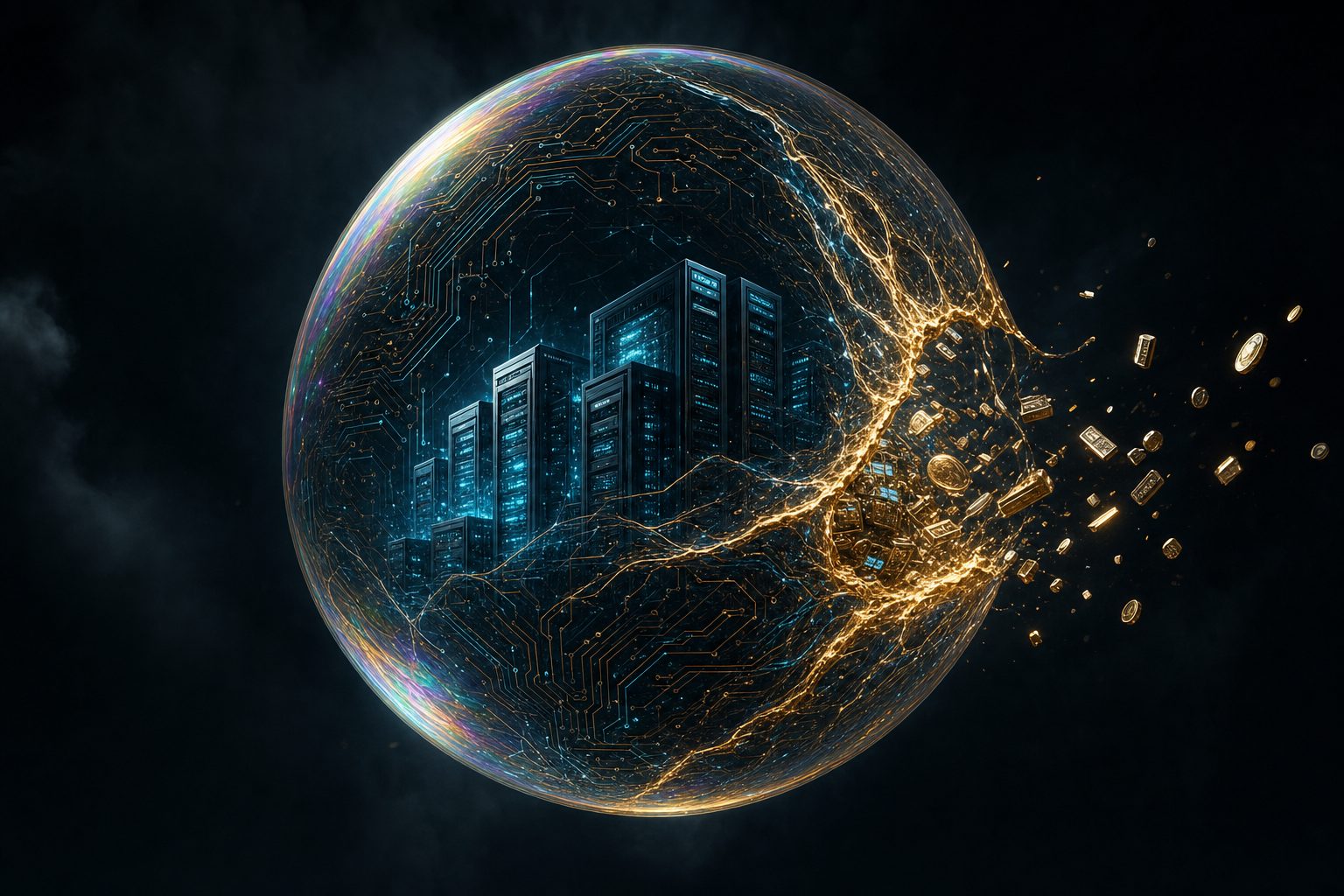
Now on the other hand, the naysayers are more dangerous. They are the ones presenting the option of comfort. The thing that says change isn't REALLY coming. It is just in your head. They are inviting you to stick your head in the sand with them and pretend like none of this is "real". If they aren't ignoring it, they are proclaiming that it is all just one big bubble. Bubbles burst. And in that way, they are right.
But also, they are completely wrong.
The Bubble Burst Blast Radius
When most people think about a bubble bursting, they think of the internet bubble — where many companies lost significant investment dollars and shut down. That's the more comfortable version of a bubble bursting. There is another bubble that burst in somewhat recent memory — the 2008 financial crisis, when the housing market bubble burst. While that certainly affected investors and banks and caused massive ripple effects throughout our economy, I don't think anyone could argue that the average homebuyer was the most impacted by that particular bubble bursting. I posit that we are somewhere in the middle with the AI bubble, and that, whether the bubble bursts or not, the average person is going to be dramatically impacted.
The problem isn't so much that AI companies are losing money currently — and they definitely are. (We'll get to that.) The problem is the bet they're making is so large that winning or losing will have massive repercussions for everyone. So the blast radius of this bubble bursting is everywhere.
We Didn't Ask For This, But Here We Are
So here we are — the average person being completely shut out of the biggest bets in the history of economics because all of these major AI companies are being privately traded. You cannot buy Anthropic stock. You cannot buy OpenAI stock. And while you can buy Google, Microsoft, AWS, NVIDIA, and Tesla stock... those are companies that are fairly diversified, so you're not betting solely on AI when you invest in them. That's not necessarily a bad thing. Certainly this is not investment advice, but it is important to know where we really stand here.
And it is a problem.
So what happens when AI succeeds? When Anthropic or OpenAI are ultimately the victors, what does that look like for us? If Anthropic is any indication, we should be worried. We should be very, very worried. And as Anthropic succeeds and continues to grow while using these pretty underhanded business strategies and acting in overall bad faith toward the developer community — which is causing them to become very rich — OpenAI and the others will eventually follow suit, because greed is all-encompassing.
So Here's What Anthropic Did
Full warning: this part is going to get a little bit technical, but bear with me. I promise I'll pull it together and make it make sense. Today, there are a few different ways you can access your Claude subscription. You can either go to Claude.ai, which is basically the same thing as using the chat app if you download it, or you can use the API. There are other ways to access it, such as using the SDK, but they have effectively rendered that moot. And that is the warning shot that we should all be paying attention to.
Now, to be fair, what Anthropic actually did was not take away the SDK, but you used to be able to use the SDK with your Claude subscription. That was extremely useful for things like Claude Code. And if you don't know, Claude Code and Claude Cowork are really the things that are making Anthropic a lot of money right now, especially Claude Code. They're not making money off the personal subscriptions. They're making money because you, as a personal buyer, have your personal subscription — use it, like it, and then go to your company, and your company buys an enterprise Claude Code license, which is either not at all or far less subsidized than the personal accounts are.
To give you an idea of how much personal accounts are being subsidized, it is anywhere from 10x to 30x. If you pay $200 for a Claude Max subscription, you get between $2,000 and $7,500 worth of inference per month if you used the API. This is an enormously good deal on the surface for personal developers. So why are we up in arms? Well, the SDK used to use your Claude Code subscription. Now it will still use it somewhat, but if you're using the SDK, you're actually being put into a new pool where you are effectively paying full API rates, so you get a $200 pool to use using the SDK. They did this mostly because OpenClaw is a thing, and OpenClaw spends a lot of tokens. If you're an OpenClaw user, you're less likely to be someone who uses Claude Code in the way they want — that is, in a way that will ultimately lead to them closing an enterprise deal.
Now here's why you should care about this. The software Anthropic released to use Claude models is closed source. Only they can view the source code, and they control everything about how you interact with their systems. Their SDK was a way to let others build on their platform, but they're effectively shutting out developers from creating better harnesses — interfaces — for their LLM.
But How Does That Affect Me?
Good AI tools don't just come from Anthropic. They don't just come from OpenAI. They come from a vibrant developer community, and consumers will consume the products of that developer community. When you squeeze that innovation at the source, it trickles down to everyone else.
Here's what that actually looks like. If I'm an open-source developer and I produce a tool built on the Claude SDK, I am effectively handcuffing any user of that tool and forcing myself — a developer who has put no money into this because it was never meant to be a money-making endeavor — into the position of having to fund everyone else's use. The average open-source developer doesn't have the money to subsidize the use of an even mildly popular tool, let alone one that actually catches on because it's a genuinely good product. It stifles innovation. And that stifled innovation is what ultimately hurts the person who just wants good software and has no idea what an SDK is.
If you care about data privacy, competition, or simply having quality software to work with, this should matter to you. This should matter to you a lot. I like Anthropic. For the most part I agree with their philosophy about creating large language models and align with many of their positions, but their business practices have made it impossible for me to trust them in the long term. They spent months either being opaque about how SDK usage would be billed or what was allowed to be pushed through their SDK, and when they did offer some clarity, they completely did a 180 on that and effectively lied to the developer community. People have put enormous effort into continuing to build a viable ecosystem around the Anthropic models. They have effectively told the developer community that if they don't get to see every single bit of data that is going through their system, then you don't get to use their system. That may be their right, but it doesn't make them evil. It does require us to scrutinize them more closely to ensure they're truly a company we can trust to steward our data.
So what does that mean to you? To me, it means this could be the beginning of the end of the extreme subsidization that has been the source of so much of the potential good from this AI revolution. Thankfully, it is not over yet.
Codex Has Entered the Chat
In an almost comical response to Anthropic tightening every single screw it can find, OpenAI — the organization vilified by the likes of Elon Musk and by Anthropic themselves — responded. Fun fact: Anthropic was spun off by a group of people who had worked at OpenAI because they didn't trust OpenAI to do the right things. OpenAI has been very accommodating, allowing people to use their ChatGPT subscriptions to access their LLMs without imposing strict limits. Their main restriction is that you shouldn't run a commercial product from your personal account, which is completely reasonable.
Now if only Codex could do front-end design. (TODO (OpenAI): Pls fix)
Codex is also massively subsidized — probably roughly the same level as Anthropic. But the more important story is what OpenAI's broader moves mean for the competitive landscape. Anthropic has been winning enterprise deals in part because OpenAI's Azure exclusivity made it unavailable to the vast majority of companies running on AWS. Azure is a good platform, but it's unlikely to beat AWS, which is Anthropic's primary cloud partner. Before now, Azure was the preferred enterprise channel for OpenAI models, with exclusive or preferential treatment for compliance certifications and enterprise features that made it the obvious choice for large organizations. Now that OpenAI has redefined its deal with Microsoft and is actively courting GCP and AWS, things are about to get very interesting. A lot of companies run on AWS, so if a company wanted to host their own private model and their entire infrastructure was on AWS, they faced a tough choice — diversify their cloud options at significant cost and complexity, or avoid OpenAI models entirely. That choice is going away.
This matters beyond brand preference. I genuinely hope that OpenAI applies real market pressure and Anthropic comes back into the fold. That's what I actually want. This isn't about preferring one product over another. It is about the need for a viable alternative — because no single entity can be allowed to control this technology. Anthropic was founded in part on that exact principle. The reason it exists is because a group of people looked at OpenAI's trajectory and decided that a tool this powerful should not be controlled by one organization. And they were right. We are already in a dangerous position having this technology controlled by even half a dozen players. AI is akin to humans mastering fire. You cannot have one fire company. It is too important to the future of civilization.
So as Anthropic pulls up the carpet behind them, I'm rooting for the market to correct them. Not because I want them to fail. Because I want them to have to be better.
Looking Ahead...
This bubble is not going to just pop like a soap bubble in midair. It is going to contort into all sorts of weird shapes. Different players will continue to emerge. I am sure Google has not been completely counted out; it will likely come back and win for a little bit, and XAI might even come from behind and actually do something meaningful. However, I think we have seen enough behavior from Anthropic in particular to know what type of company they have chosen to be. Time will tell whether this will really be the path that all of the labs eventually take. Anthropic is just an unfortunate trailblazer, or the market will actually correct Anthropic, as I hope it does.
I like Anthropic. I like OpenAI. I use both of their products every single day, and my life is materially better because of them.
But it is hard to deny that Anthropic is doing its best to burst the bubble in a way that will do the most damage to average, everyday people. And the window to get ahead of that is starting to close.
So here is what I actually want you to do. Download Codex. Download Claude. Sit with them for a while. Think about the things in your life you don't like doing — tasks you could automate, processes you wish had a little more rigor, tools you use every day that you wish worked differently. You don't need to build the next startup. You just need to describe the problem and define what good looks like, and then try to build the thing. It will suck at first. Keep going. In that process you will get better at understanding what you actually do, and you will get better at communicating intent and exercising judgment. Those are skills that will outlast every product cycle, every bubble, and every pivot any of these companies ever make.
The free window may be closing. Use it.